
Reviewed · MARAMUREȘ & MONASTERIES
3 Day Tour of Maramures
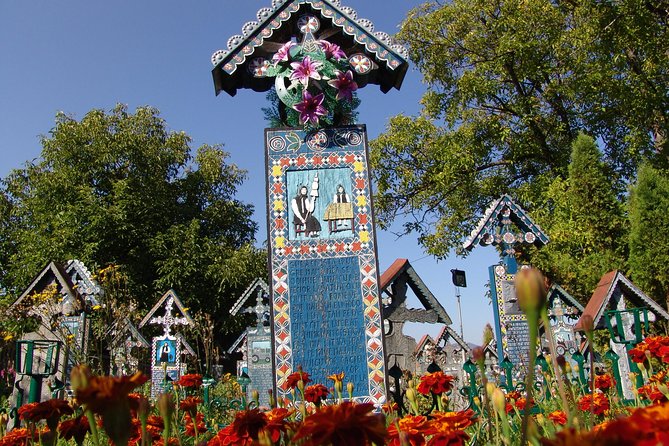
Merry Cemetery is the kind of place that changes your idea of what a cemetery can be. Its carved wooden crosses use bright colors, especially Săpânța blue, and tell each person’s story with pictures, poetry, humor, and the occasional unflattering detail. This three-day tour then carries you through Maramures villages where crafts and old customs are still part of daily life.
I like the mix of serious history and living tradition. You move from the former prison at Sighet, one of Romania’s strongest museums about communism, to homes, workshops, farms, and village communities. I also like the personal scale: this is a private tour, and a trusted local guide such as Teo can translate and introduce you to people in a way a large coach group cannot.
The main drawback is the amount of driving. Maramures is spread out, and several stops are short. You should also budget separately for meals, drinks, snacks, tips, and personal purchases. At $763.34 per person, the tour is not a bargain-basement outing, but the private transport, guide, accommodation, breakfasts, and admissions make the price easier to assess.
What makes this Maramures tour special
- Săpânța blue crosses: Merry Cemetery presents village life and death through carved images, colorful paint, and verse.
- A former communist prison: The Sighet Memorial uses prison cells as museum rooms covering Romania from 1945 to 1989.
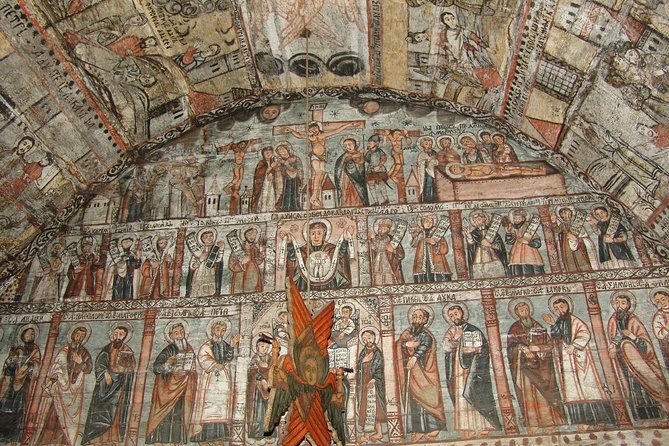
- Wooden churches and monasteries: Săpânța-Peri and Bârsana show the skilled timber building tradition of the region.
- Crafts in working villages: You can see wool weaving, Dacian-style pottery, wood carving, sheepskin masks, and old household tools.
- Real local contact: In Breb, Botiza, and Săcel, you meet people working in their homes and communities rather than only viewing displays.
- A private three-day format: Your group travels by private transport with an English-speaking local guide and returns to Cluj-Napoca.
Why Maramures rewards a three-day visit
Maramures is best understood through contrasts. One moment you are looking at a beautifully carved wooden cross; the next, you are inside a former prison confronting political repression. A little later, someone is showing you how wool is woven or how a water-powered machine still serves local needs.
That range is the real strength of the trip. It is not simply a sightseeing circuit of pretty churches. You get religion, folk art, family memory, 20th-century politics, and practical village work.
The private format matters here. Many of the most interesting encounters depend on introductions and translation. The guide does more than point out buildings. A local guide such as Teo can help you speak with residents, explain customs, and make the visits feel like personal meetings rather than staged demonstrations.
You should still set the right expectations. This is not a slow retreat with long breaks at every stop. The days include several visits, and the return to Cluj-Napoca on the third day adds more road time. The reward is breadth: in three days, you see a great deal of northern Transylvania that would be difficult to connect on your own.
Other monasteries and painted churches from Cluj Napoca:
- Maramures best, full day tour from Cluj
★ 5.0 · 33 reviews - From Cluj-Napoca: Maramures Day Tour
★ 5.0 · 19 reviews - Two days tour to Maramures: local experiences and culture
★ 5.0 · 9 reviews
Day one: Săpânța blue and the story of Sighet
The first day begins at 9:30 a.m. from Piața Unirii 15 in Cluj-Napoca. The first stop is Merry Cemetery in Săpânța, with about an hour and a half to look around.
The cemetery’s wooden crosses are painted in a strong blue and decorated with carved scenes from the lives of the people buried there. The epitaphs are written in verse. Some honor a person’s good qualities, while others include humor or admit to less admirable habits.
That directness is what makes the cemetery memorable. It presents a community through individual stories, not through polished monuments. Take time to read the panels and study the pictures. If you rush through for photographs, you will miss the point.
Next comes Săpânța-Peri Monastery, with a half-hour visit. The wooden church rises about 75 meters and is described as the tallest wooden church in the world. The setting adds to the appeal, but the main sight is the structure itself: a large-scale example of Maramures timber building.
Thirty minutes is enough for a focused look, though not for a long visit. If you care about church architecture or wood construction, you may wish the schedule allowed more time. Still, paired with the cemetery, it gives you two very different expressions of local artistic skill in the same area.
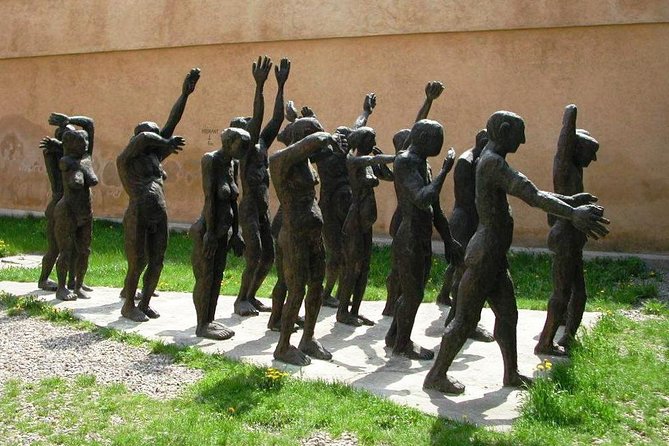
The afternoon turns to darker ground at the Memorial of the Victims of Communism and of the Resistance in Sighet. The museum occupies a former prison, and the old cells now hold exhibits about Romania from 1945 until the fall of the Berlin Wall in 1989.
Plan on an hour and a half here. The museum examines the communist system and the wider nature of totalitarian rule. Using the prison itself as the setting gives the material a strong physical presence. You are not simply reading about repression in a modern gallery. You are moving through the rooms where prisoners were held.
This is likely to be the most demanding stop emotionally and mentally. The exhibits cover recent history, so the material is closer to the present than the medieval churches and folk traditions seen elsewhere. I would give this visit your full attention and avoid treating it as a quick stop between scenic locations.
The final visit of the day is the Elie Wiesel Memorial House, the Museum of Jewish Culture in Maramures. Wiesel, the Nobel Peace Prize winner and author of Night, was born in this house. The displays focus largely on Jewish life and the Holocaust.
The scheduled visit is about 30 minutes. If available and desired, the visit can also include the Sephardic Synagogue, Jewish Cemetery, and Holocaust Monument. Because the time is short, ask the guide how these options fit into the day.
Day one has a clear emotional arc. It begins with colorful folk memory, moves through religious architecture, then confronts dictatorship and Holocaust history. That variety is valuable, but it can also feel full. You will have a better experience if you accept that the day is about discovery rather than leisurely lingering.
Day two: Bârsana, weaving, and old village skills
Bârsana Monastery leads the second day. The complex is built in wood and surrounded by flowers and countryside. You have about an hour and a half here, enough to see the main buildings without being pushed through.
The monastery is one of the strongest visual stops on the tour. Its wooden construction gives the complex a unified look, while the setting makes it pleasant to walk around. The visit also provides useful context for the later craft stops: in Maramures, wood is not just a decorative material. It has long been part of religious buildings, homes, tools, and household objects.
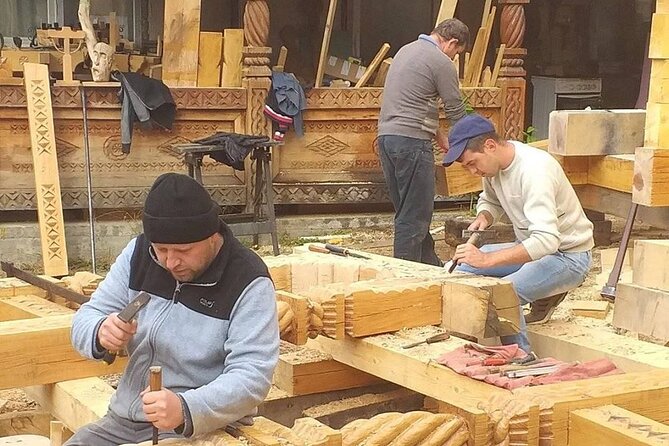
In the same village, you visit the largest wood-carving workshop. The pairing works well. First you see grand wooden architecture, then you see the hands-on craft behind the region’s carved forms.
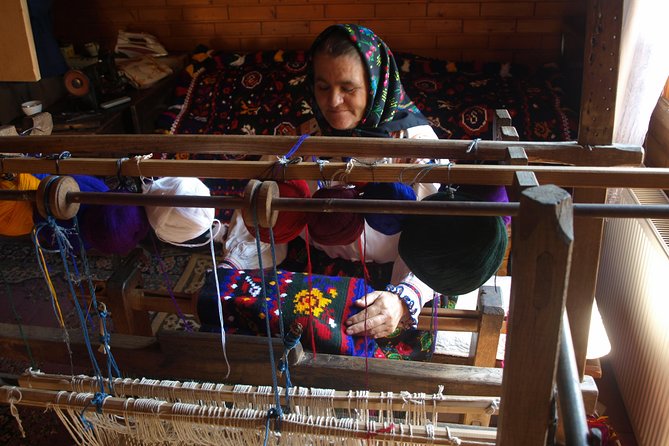
Botiza shifts the focus from wood to wool. You meet a woman who weaves wool rugs colored with plant dyes and decorated with older motifs. Traditional wall-carpet craftsmanship in Maramures was added to UNESCO’s Representative List of the Intangible Cultural Heritage of Humanity in 2016.
That status matters because it identifies a living practice, not only an old object in a case. You can see how regional identity is carried through materials, patterns, and methods. The visit lasts about an hour and is free of an admission charge.
The tour also takes you into the village to see people working in the fields and a mineral spring. These details help keep the day grounded in ordinary life. You are not only looking at finished crafts. You are seeing how work, land, and local customs connect.
Săcel brings several encounters together in about an hour and a half. You visit the only ceramist in the area still making Dacian-style unglazed pottery. The rough, unglazed finish gives the pieces a clear link to an older style of production.
If available, you may also meet someone who makes ritual masks from wool and sheepskin. A wood carver and a woman living in a 100-year-old wooden house are also part of the planned visit. Availability matters here, so do not assume every person will be present at every departure.
Săcel is one of the clearest examples of why a private guide is useful. Several separate people and skills are involved, and introductions are not something you can easily arrange during an independent drive. The visit is strongest if you are curious and willing to ask questions rather than simply watch a demonstration.
Day three: Breb, water power, and the road home
The final day begins in Breb, where you meet local residents, including the village poet, and visit a craft workshop. The planned time is about 70 minutes.
Breb gives the tour a social finish. After two days of churches, memorials, and craft traditions, you spend time with people who live in the village now. The presence of a village poet adds a personal and cultural angle, while the workshop gives you another look at local making.
Sarbi follows with a visit to a group of water-powered farm machines that still serve community needs. You see a fulling mill, carding mill, whirlpool, and alcohol distillery, with about an hour at the stop.
This is a particularly useful visit because it shows technology as part of village life, not as a museum display. Water power is linked to work: processing wool, handling textiles, and producing other necessities. The machines make the older economy easier to understand.
The last stop is Budesti. Here you see what is described as Romania’s most unusual optical illusion, along with a fine medieval wooden church. The visit lasts about an hour before the return to Cluj-Napoca.
The optical illusion is a fun change of pace after the heavier subjects earlier in the tour. The wooden church brings the trip back to the region’s religious architecture and timber tradition. You then return to the original meeting point in Cluj-Napoca.
Because Budesti comes before the drive back, timing may feel tight on the final day. Keep personal plans in Cluj-Napoca flexible until the tour ends. The exact return time is not provided.
Other three-day trips from Cluj Napoca:
- 3-Day Medieval Transylvania Package Tour
★ 4.7 · 31 reviews - 3-Day Explore Transylvania from Bucharest
★ 5.0 · 17 reviews - 3-Day Tour of Transylvania’s Landmarks from Bucharest
★ 5.0 · 16 reviews - 3-Day Private Tour of Medieval Transylvania from Bucharest
★ 5.0 · 15 reviews
The guide, transport, and private format
Private transportation is included, and only your group participates. That gives you more control than a standard group excursion, even though the route itself is fairly structured.
A local English-speaking guide is included. Teo is specifically associated with the experience, and the strongest value of a guide here is not just historical explanation. It is translation and access. In village homes and workshops, a local intermediary can help you speak directly with people and understand what you are seeing.
The tour requires a moderate level of physical fitness. You should expect to get in and out of transport repeatedly, walk around religious complexes and villages, and spend long periods on the road. The information provided does not give a vehicle type or exact driving times, so ask the operator if those points are important to you.
Two nights of three-star accommodation and two breakfasts are included. Lunches, dinners, drinks, and snacks are not. That arrangement lets you choose your own meals, but it also means the advertised price is not an all-inclusive total.
Is $763.34 per person good value?
At $763.34 per person, this tour costs more than a simple bus trip between sights. You are paying for private transport, a professional local guide, two hotel nights, two breakfasts, admission fees, and a route that links places that are not easy to combine without planning.
The value is strongest for a couple or small private group that wants personal introductions and does not want to organize rural transport, lodging, and entry tickets separately. It is less attractive if your priority is the lowest possible price or a relaxed schedule with only one major sight each day.
Group discounts may be available, which could improve the per-person cost for a larger booking. Since meals are excluded, I would also allow room in your budget for three days of food and drinks, plus tips and souvenirs.
The four listed reviews give the experience a 5.0 rating, but the small number means you should not treat that score as a complete measure for every kind of visitor. The detailed praise centers on local contact, guide quality, and the feeling of meeting people in their normal surroundings. Those are precisely the elements that justify the higher price.
Who should book this tour?
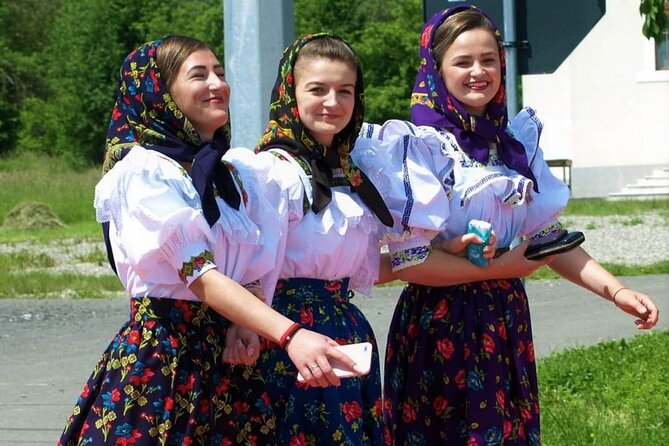
I would recommend it to you if you want more than monuments. The tour suits people who care about folk crafts, village life, recent Romanian history, Jewish heritage, wooden architecture, and personal contact with local residents.
It is also a good match if you value convenience. The route, transport, hotels, breakfasts, admissions, and English guidance are arranged in one package. You do not need to coordinate several rural stops yourself.
I would hesitate if you dislike long road days, prefer plenty of free time, or want every stop to be guaranteed. Some personal encounters depend on availability, and the schedule covers a lot of ground.
You can cancel for a full refund if you do so at least three full days before the experience begins. Changes or cancellations inside that period are not accepted for a refund. Confirmation is normally issued when you book, although bookings made within two days of departure may take up to 48 hours and remain subject to availability.
Should you book the three-day Maramures tour?
Book it if your ideal Romania trip includes real village contact, not just famous buildings. The combination of Merry Cemetery, the Sighet prison museum, Bârsana Monastery, working craftspeople, and water-powered machinery gives you a fuller picture of Maramures than a quick day trip can provide.
Skip it if you need a slow itinerary or want meals and personal expenses covered. For the right person, the cost buys access, context, and a practical route through a rural region that is difficult to arrange alone. The most memorable part may not be the tallest church or the oldest object, but the conversation made possible by a local guide.
FAQ
Where does the tour start?
It starts at Piața Unirii 15, Cluj-Napoca 400394, Romania.
What time does the tour begin?
The stated start time is 9:30 a.m.
Where does the tour finish?
The tour ends back at the original meeting point in Cluj-Napoca.
How long is the experience?
The tour lasts approximately three days and includes two nights of accommodation.
Is this a private tour?
Yes. Only your group participates in the activity.
Is an English-speaking guide included?
Yes. A professional local guide is included, and the tour is offered in English.
What is included in the price?
Private transportation, all fees and taxes, two nights of three-star accommodation, a professional local guide, and two breakfasts are included.
Are meals included?
Only the two breakfasts are included. Lunches, dinners, drinks, snacks, travel insurance, tips, souvenirs, and other personal expenses are not included.
Just added around Cluj Napoca
- Turda Salt Mine, Gorge & Rimetea Village (private from Cluj)★ 5.0 · 5 reviews
- Private tour to Turda Salt Mine, Rimetea and Alba Iulia★ 4.8 · 5 reviews
- Turda salt mine and Corvin Castle day tour from Cluj★ 5.0 · 9 reviews
- Two days tour to Bucovina & UNESCO Painted Monasteries★ 5.0 · 3 reviews
- Transylvania: Dracula’s Castle and Birthplace Tour★ 4.5 · 28 reviews
- Turda Gorge, salt mine and Rimetea village private tour★ 5.0 · 12 reviews
- Sighisoara, UNESCO & wine tasting (1 day, from Cluj)★ 5.0 · 4 reviews
- Snowshoeing Fun Tour from Cluj Napoca★ 4.5 · 7 reviews
Maramureș & Monasteries, compared.

3-Castle: Peles,Bran,Rasnov,Sinaia Monastery from Brasov w pickup
Read our review →
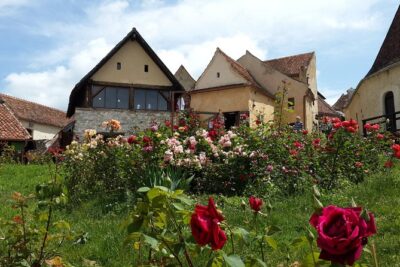
Peles Castle, Bran Castle, Rasnov Fortress and Sinaia Monastery Tour from Brasov
Read our review →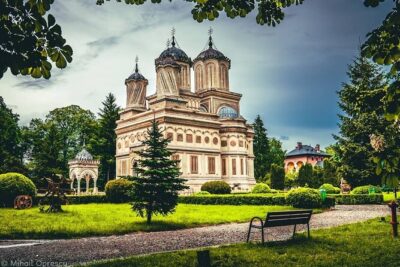
Princely Court of Târgoviște and Curtea de Argeș Monastery
Read our review →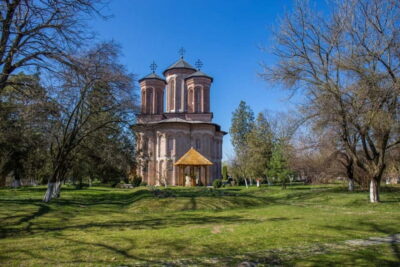
Small Group Tour to Mogosoaia Palace & Snagov Monastery
Read our review →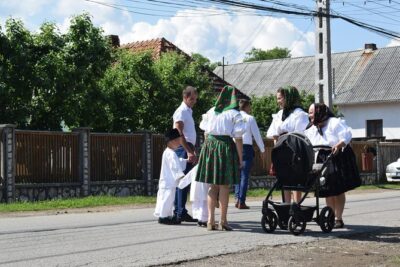
1-Day Bucovina Painted Monasteries tour from Suceava – English
Read our review →
Sacred Monasteries Private Tour: Snagov, Țigănești & Căldărușani
Read our review →Browse the lists this tour appears in