
Reviewed · TOURS IN BUCHAREST
Unique Tour of Hidden Bucharest
Bucharest’s best surprises often sit just off its major avenues: old mahallas, fading mansions, Orthodox churches, and quiet lanes where Armenian, Jewish, French, German, Ottoman, and Romanian influences meet. This walking tour takes you into those less-noticed corners, with the National Theatre as its starting point and Parcul Ion Voicu as one of its main areas.
I like two things right away. First, the tour explains why Bucharest looks so mixed up, rather than simply pointing at pretty buildings. Second, the small maximum of 12 people leaves room for questions and route changes. The possible catch is that the advertised timing varies between about two and a half and three hours, and the walk requires moderate fitness.
Key points to know before booking
- Quiet central neighborhoods: Explore Batiștei, Mantuleasa, Armenian, Jewish, Olari, Icoanei, and Ioanid areas away from the main avenues.
- Architecture with a story: Learn how Belle Epoque, Ottoman-influenced, Orthodox, French, German, Armenian, Jewish, and communist-era buildings came together.
- A genuinely small group: The tour accepts no more than 12 people, and some departures have operated as private walks for solo bookers or small groups.
- Local guides with different personalities: Guides including Andreea, Ioana, Irina, Alex, Elena, Anita, Tudor, Roxana, LaLa, and Mircea have led this experience.
- Refreshments are part of the rhythm: Snacks are included, while cafés, tea houses, garden restaurants, and alcoholic drinks are available to purchase.
- Good first-day orientation: The walk gives you practical ideas for restaurants, cafés, photography spots, and further exploring.
Why Bucharest’s side streets tell the better story
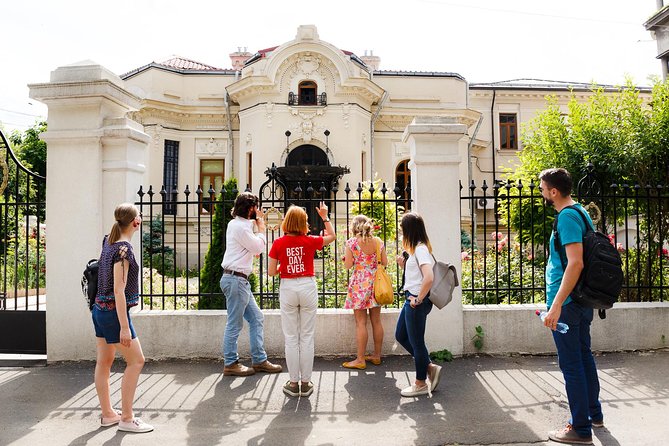
Bucharest can feel confusing at first. Grand boulevards, concrete apartment blocks, elegant old houses, Orthodox churches, and half-restored mansions may appear within a few minutes of one another. This is not a city with one neat architectural identity.
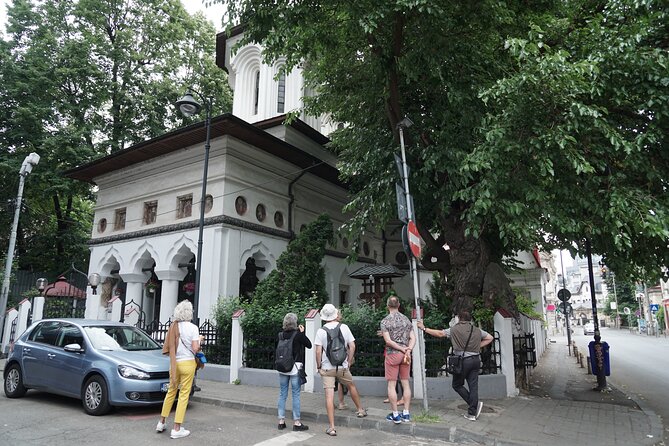
That confusion is the point here. The tour explains how Bucharest grew through small quarters called mahallas. These districts often formed around a religious building and were linked to particular ethnic, social, or religious communities. As the city expanded, the mahallas blended together and later suffered earthquakes, wars, modernization, and Nicolae Ceaușescu’s demolition schemes.
I like this approach because it gives you a useful key for reading the city. Instead of seeing an old house as simply beautiful but run-down, you begin to ask who built it, who lived there, what political changes affected it, and why it may still be empty.
The walk is not designed as a checklist of famous sights. It is better suited to you if you want context, architecture, and everyday city texture. You may pass a building that is easy to miss from a taxi window, then spend several minutes learning why its entrance, windows, courtyard, or condition matters.
Other days travellers book out of Bucharest:
- Bucharest: Dracula’s Castle, Peles Castle, & Brasov Old Town
★ 4.5 · 17,858 reviews - Bucharest: Dracula Castle, Peles Castle & Brasov Old Town
★ 4.6 · 10,891 reviews - Bucharest: Dracula’s Castle, Peleș Castle & Brașov Day Trip
★ 4.5 · 5,919 reviews
Starting at the National Theatre at 10 a.m.
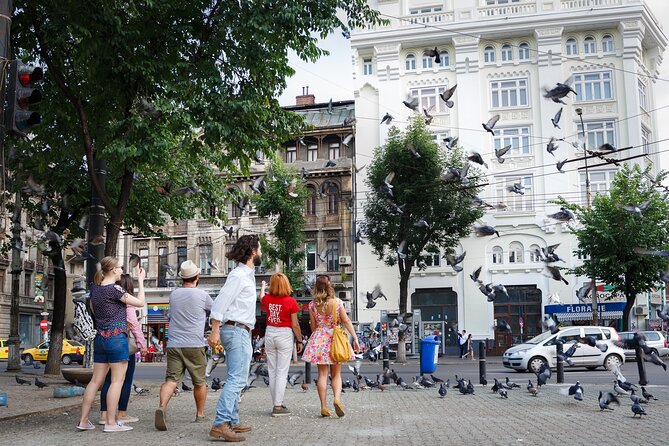
The tour begins at the Ion Luca Caragiale National Theatre on Bulevardul Nicolae Bălcescu 2. The meeting point is central and near public transportation, which makes the morning start fairly simple if you are staying in central Bucharest.
The National Theatre is more than a convenient landmark. It sets up the tour’s main subject: Bucharest as a city shaped by several cultural and political forces. The introduction covers the relationship between the Romanian lands and the Ottoman Empire, while making clear that Bucharest was not itself an Ottoman town.
That distinction matters. Bucharest shared some features with towns in the Ottoman sphere of influence, including the mahalla pattern, but it also developed its own mixture of local, European, and regional traditions. A good guide can make this history feel connected to the street in front of you, rather than like a detached lecture.
The first section is listed at about 30 minutes, with no admission fee. You should expect to walk and listen outdoors, not enter a major museum or theater as part of the standard route.
Batiștei and the old quarters between the avenues
From the National Theatre, the walk moves toward Strada Batiștei and nearby neighborhoods. This is where the city’s layered past becomes easiest to see. Batiștei, Mantuleasa, the Armenian Quarter, and the old Jewish Quarter each add a different part of the story.
The guide explains the mahalla idea and how these small districts merged as Bucharest grew. You also hear how earthquakes, wars, modernization, and communist demolition projects altered them. The result is an area where polished restorations can sit close to cracked facades, abandoned houses, newer businesses, and apartment buildings.
This section lasts about 35 minutes in the listed plan, though the full walk also includes several nearby areas. Guides have taken people through Olari, Icoanei, and Ioanid as well. The exact emphasis can shift depending on the group, the guide, and questions along the way.
That flexibility is useful if you care about a particular subject. A photographer may spend more time on unusual facades and old courtyards. Someone interested in communist Bucharest may ask more about demolition and property disputes. A visitor who wants food advice can receive restaurant suggestions for different neighborhoods.
The tradeoff is that the route may not always feel tightly scripted. One guide may favor a clear sequence, while another may adapt the walk around your interests. If you prefer a fixed list of sights with precise timing, this can feel loose. If you enjoy following a local’s eye, it is part of the appeal.
Parcul Ion Voicu and the Belle Epoque streets
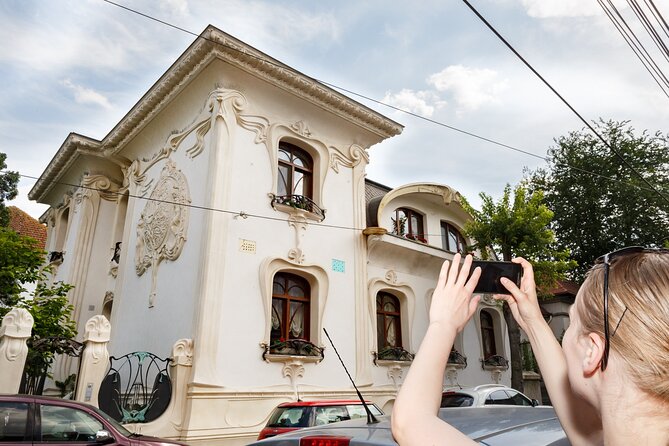
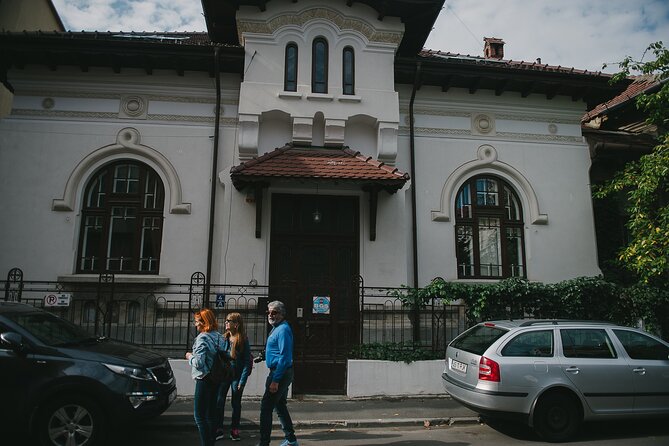
The walk’s third named stop is Parcul Ion Voicu, a pleasant area associated with late nineteenth-century Belle Epoque mansions. This is one of the strongest sections for architecture lovers.
The mansions help explain why Bucharest was once known for elegant private homes and grand urban ambition. At the same time, many buildings have deteriorated. Some are restored, some are being repaired, and some remain empty or disputed. That contrast gives the walk an honest edge.
You will not see a perfectly polished old town. Bucharest’s older streets can be frayed, patched, and uneven. But that condition also reveals the city’s recent past. Guides have explained how communist-era policies, later ownership problems, and the difficult shift to a market economy affected these homes.
I particularly like this part for visitors who want to understand why Bucharest can feel both graceful and unfinished. You may see delicate architectural details on one house and serious neglect on the next. The guide’s job is to connect those visual clues to the events that shaped them.
The stop is listed at about 40 minutes. The route may also include the Icoanei and Ioanid areas, where old homes, gardens, and quieter streets provide a break from the city’s larger traffic corridors.
Same base, a completely different day:
- Bucharest: Palace of Parliament Tickets and Guide
★ 4.3 · 3,182 reviews - Bucharest: Day Trip to Dracula Castle, Peles Castle & Brașov
★ 4.4 · 3,049 reviews - Bucharest to Dracula Castle, Peles Castle and Brasov Guided Tour
★ 4.5 · 2,933 reviews - Bucharest: Palace of Parliament Tickets and Guided Tour
★ 4.4 · 1,877 reviews
Churches, cafés, gardens, and the human side of the walk
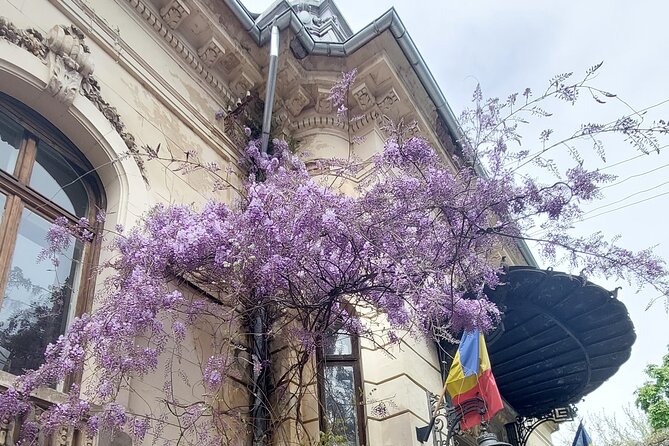
Refreshments help break up the architecture talk. Snacks are included, while food and drinks beyond what is specified are not. Alcoholic drinks are available to purchase, but you should not treat this as a food tour or a full meal.
The exact refreshment stop can vary. Past walks have included cafés, summer gardens, historic tea houses, and small restaurants. Stops mentioned by guides include Simbio and Share Café, while some walks have ended at a garden restaurant or another local place for lunch.
That flexibility means you should arrive with realistic expectations. You may receive a traditional Romanian pastry or another snack, and a guide may suggest a good place for lunch. But the tour does not promise a set menu, a formal tasting, or drinks included throughout.
The food stops matter because they turn a history walk into a practical introduction to Bucharest. Guides have offered restaurant advice, helped with reservations, and suggested places suited to specific needs, including gluten-free dining. One guide brought traditional Romanian cake for an Easter departure, a small gesture that shows how personal the experience can become.
You may also visit a church if one is open during the walk. An Easter Sunday departure included entry to a beautiful church, but that should be treated as a fortunate possibility, not a guaranteed part of every tour.
What the guides add to the experience
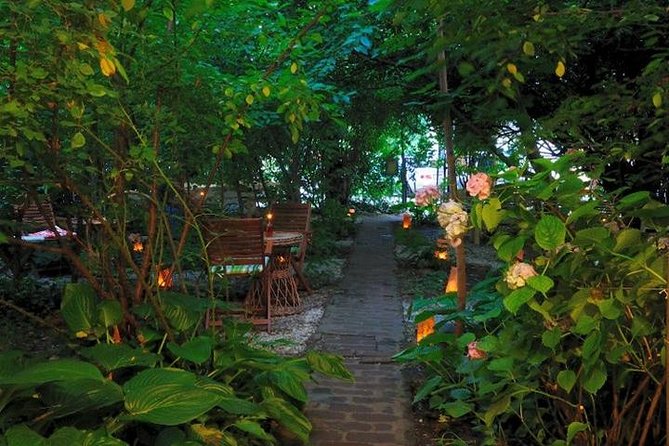
This tour depends heavily on the person leading it. The listed provider is Interesting Times Bureau, and the guides have included Andreea, Ioana, Irina, Alex, Elena, Anita, Tudor, Roxana, LaLa, and Mircea.
Several guide styles come through clearly. Andreea has been described as a Bucharest local who explains neighborhoods like Batiștei, Armenian, Mantuleasa, Olari, Ioanid, and Icoanei with warmth and practical restaurant advice. Ioana is associated with strong cultural and architectural knowledge, while Anita has adjusted a walk for photography interests.
LaLa has led relaxed introductions for people arriving in Bucharest with little idea of how the city works. Mircea has been praised for explaining architecture and for taking care with comfort during very hot weather. On one occasion, when a participant could not walk the final hour, he arranged a car from the office so the tour could continue by vehicle.
You should not assume you will receive a particular guide unless your booking confirms one. The useful point is that the tour has room for a guide to respond to your interests instead of delivering only memorized facts.
This is also why asking questions helps. If you want more on architecture, communist planning, religious communities, photography, or food, say so early. The route can be adapted while staying focused on Bucharest’s neighborhoods.
How much walking and time should you expect?
The experience is sold as roughly three hours, while the stated duration is about two hours and 30 minutes. Past walks have run a little over two hours, and others have filled close to three hours. Plan on a substantial city walk rather than a brief orientation.
You need moderate physical fitness. Wear supportive shoes, especially because the route includes ordinary city streets rather than a smooth museum circuit. In summer, carry water and be ready for heat. A guide has helped people stay hydrated during extreme temperatures, but personal preparation still matters.
The start is at 10 a.m. and the finish is near the KFC on Bulevardul General Gheorghe Magheru 28 to 30. That ending point is useful for continuing into central Bucharest, finding lunch, or returning to public transportation.
Hotel pickup and drop-off are not included. You make your own way to the National Theatre and arrange your return from the finish. Since the tour is central, this is less of a burden than it would be for an outlying attraction, but leave enough time to find the meeting point.
Is $46.86 a fair price?
At $46.86 per person, this is not the cheapest way to spend a morning in Bucharest. You could walk through central neighborhoods alone for almost nothing. The value comes from the interpretation, local orientation, and access to places you might otherwise pass without understanding.
The small group limit helps justify the cost. With no more than 12 people, the guide can answer questions and adjust the pace. If only one person or a small party books, the walk can feel close to private, though one solo participant noted that paying for two places was required in that situation.
For me, the price makes the most sense early in a Bucharest stay. You receive neighborhood names, architectural clues, restaurant ideas, and a clearer sense of how the city fits together. That information can improve the rest of your visit.
It is less suitable if you only want landmark photos, a museum admission, or a scheduled food tasting. You are paying for a guided city walk and interpretation, not a large number of included attractions.
Who should book this walk?
I would choose this tour for a first or second day in Bucharest if I wanted to get my bearings without spending the morning on the standard monuments. It also suits repeat visitors who have already seen the main avenues and want quieter streets.
Architecture fans will get the most from it. So will anyone curious about how Armenian, Jewish, French, German, Romanian, Ottoman-influenced, Orthodox, and communist elements ended up side by side.
It is also a good match for solo visitors. Small departures have sometimes operated with one participant, creating plenty of time for questions and personal recommendations. Couples and small groups can gain the same benefit without needing to arrange a private guide separately.
I would think twice if you dislike walking, hot weather, uneven city conditions, or open-ended storytelling. The route can feel less exact than a tightly timed sightseeing tour, and the older buildings are not all restored. That is central to the experience, not a flaw to hide.
Booking details worth knowing
The tour is offered in English, includes a mobile ticket, and confirmation is provided when you book. Group discounts may be available. You can cancel for a full refund up to 24 hours before the local start time, but changes or cancellations inside that window are not accepted.
The maximum group size is 12. Food and drinks are not generally included beyond the specified snacks, and alcoholic drinks cost extra. Because the meeting point and end point are different, check both locations before leaving your accommodation.
Should you book the Unique Tour of Hidden Bucharest?
Book it if you want Bucharest to make more sense, not just look attractive in photographs. The best parts are the mahalla story, the Belle Epoque houses around Parcul Ion Voicu, the quieter streets near Batiștei, and the chance to ask a local guide about details you would likely miss alone.
Skip it if your priority is a fast tour of famous landmarks or a formal meal. For everyone else, the small group, flexible route, useful neighborhood advice, and strong guide-led storytelling make $46.86 a reasonable cost for a more personal introduction to the capital.
FAQ
Where does the tour begin?
It begins at the Ion Luca Caragiale National Theatre, Bulevardul Nicolae Bălcescu 2, Bucharest.
What time does the tour start?
The scheduled start time is 10 a.m.
Where does the tour finish?
The listed end point is the KFC at Bulevardul General Gheorghe Magheru 28 to 30, Bucharest.
How long does the tour last?
The duration is approximately two hours and 30 minutes, while the tour is also described as a three-hour experience. Allow roughly two and a half to three hours.
What language is offered?
The tour is offered in English.
How many people can join?
The maximum group size is 12 travelers.
Is hotel pickup included?
No. Hotel pickup and drop-off are not included.
Are food and drinks included?
Snacks are included. Other food and drinks are not included unless specified, and alcoholic drinks are available to purchase.
Do I need to be physically fit?
You should have a moderate level of physical fitness because this is a walking tour through central Bucharest neighborhoods.
Can I cancel for a refund?
Yes. You can cancel at least 24 hours before the experience begins for a full refund. Cancellations or changes made less than 24 hours before the start time are not accepted.
Just added around Bucharest
- Bucharest Panoramic City Tour & Street Food★ 5.0 · 4 reviews
- Bucharest City Tour with Village Museum★ 4.6 · 5 reviews
- Bucharest: Communism, Revolution & City Highlights Tour★ 5.0 · 9 reviews
- Bucharest City Tour – A Day to Remember★ 4.6 · 3 reviews
- Bucharest City Tour and Wine Tasting★ 5.0 · 3 reviews
- Bucharest: Private City Tour Guided Experience★ 4.8 · 8 reviews
- Bucharest: Charm of the Belle Époque Private Tour★ 5.0 · 3 reviews
- Bucharest: Carpathian Snowmobile / ATV Adventure Tour★ 5.0 · 8 reviews
Tours in Bucharest, compared.
Dracula’s Castle, Peles Castle, & Brasov Old Town
Read our review →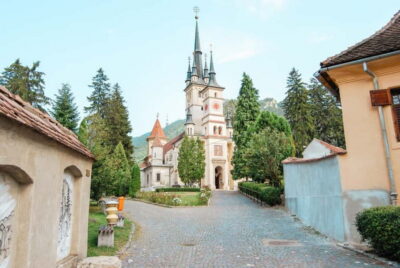
Dracula’s Castle, Peleș Castle & Brașov Day Trip
Read our review →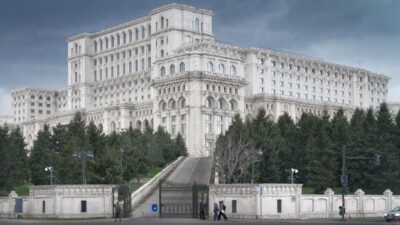
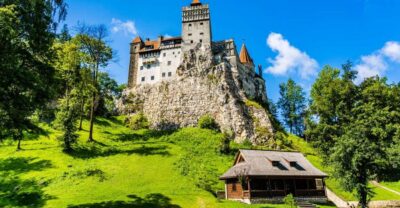
Day Trip to Dracula Castle, Peles Castle & Brașov
Read our review →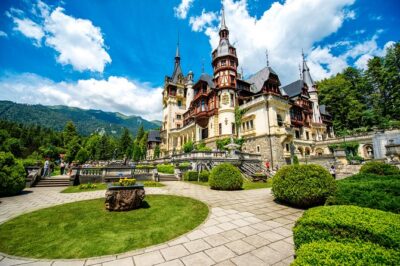
Bucharest to Dracula Castle, Peles Castle and Brasov Guided Tour
Read our review →
Dracula’s Castle, Peles Castle and Brasov Day Trip from Bucharest
Read our review →
Transylvania and Dracula Castle Full Day Tour from Bucharest
Read our review →Browse the lists this tour appears in