
Reviewed · TOURS IN BUCHAREST
Darkside Tour of Bucharest – small group
Bucharest’s darkest stories are not locked in a museum. They sit among tombstones at Bellu Cemetery, echo through Revolution Square, and surface along Calea Victoriei, where scandal and social change once shared the same streets. This tour links those places with stories about murder, love, political violence, dictatorship, protest, and the fall of communism.
I like the small group limit of 12, which gives guides such as Vlad, Elena, Alex, and Andra room to answer questions instead of delivering a speech to a crowd. I also like the mix of cemetery architecture and recent political history. The snack and included subway ride add practical value. The main drawback is the subject matter: this is not a light sightseeing walk, and the roughly three-hour route requires a moderate level of fitness.
Key points at a glance
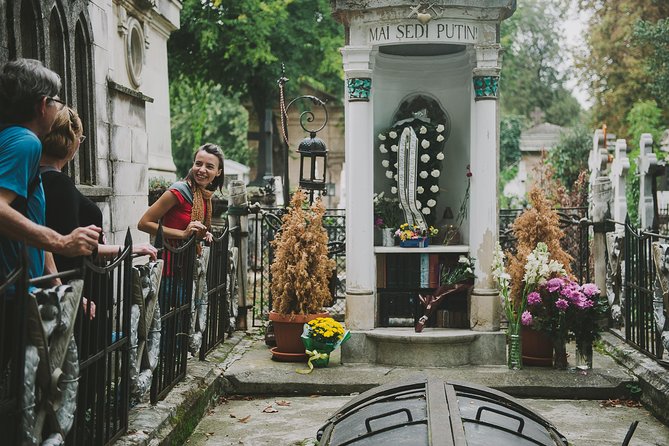
- Bellu Cemetery takes about an hour: Expect tombstones, family monuments, love stories, unusual personalities, and unresolved mysteries in Bucharest’s first modern cemetery.
- The tour connects old scandals with recent trauma: Calea Victoriei brings stories from early 20th-century Bucharest, while Revolution Square covers the 1989 uprising and communist rule.
- Guides make or break the experience: Vlad, Elena, Alex, Andra, Bogdan, and other guides are praised for clear English, humor, warmth, and strong command of Romanian history.
- Subway travel is included: You meet near the National Theatre and use the metro to reach Bellu Cemetery, then continue on foot.
- This is history with an edge: Expect prostitutes, secret police, political prisoners, revolutionary deaths, folklore, and local customs.
- The price is fair for a three-hour small group: At $48.39 per person, the value rests mainly on the guide and the depth of the stories.
Why Bucharest’s dark side makes a good first walk
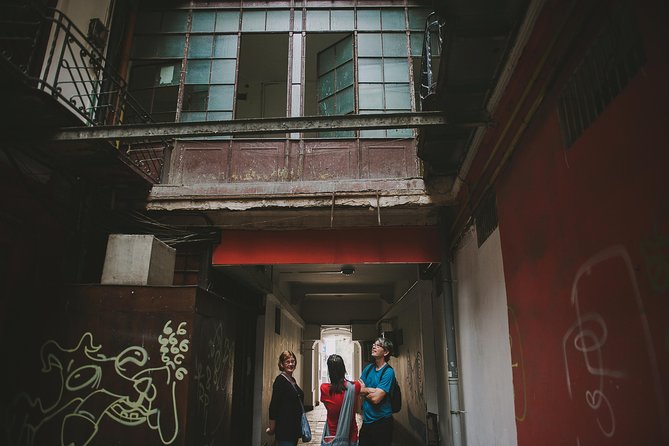
Many city tours give you a quick sweep of churches, grand buildings, and boulevards. This one asks a different question: what happened here when ordinary people faced crime, censorship, state violence, or sudden political change?
That approach helps you understand Bucharest as more than a pretty collection of old buildings and Communist-era blocks. The tour moves from the stories of individuals buried at Bellu Cemetery to public events that changed Romania. You hear about the Romanian gulag, Nicolae Ceaușescu, the secret police, the 1989 Revolution, and anti-corruption protests that began at University’s Square.
I like this structure because the history stays human. Instead of treating communism as a distant chapter, the guide explains how hard daily life became in the 1980s and how quickly events turned violent in December 1989. The stories also include folklore, local superstitions, romance, crime, and humor, so the tour does not become a dry political lecture.
You should know that the tone can shift quickly. One moment you may be hearing about a famous dancer or a carved cemetery monument. The next, you may be standing at the place where people were shot while facing the Securitate, Romania’s secret police. A good guide handles those changes with care, and the feedback from the experience points to guides who use humor without making light of suffering.
Other days travellers book out of Bucharest:
- Bucharest: Dracula’s Castle, Peles Castle, & Brasov Old Town
★ 4.5 · 17,858 reviews - Bucharest: Dracula Castle, Peles Castle & Brasov Old Town
★ 4.6 · 10,891 reviews - Bucharest: Dracula’s Castle, Peleș Castle & Brașov Day Trip
★ 4.5 · 5,919 reviews
Bellu Cemetery, where monuments tell the story
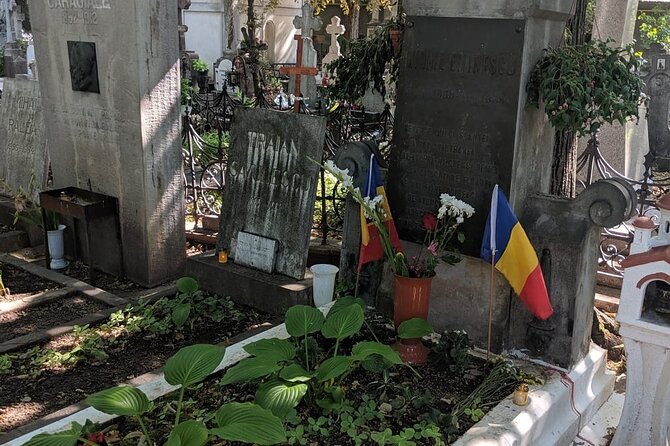
The tour begins with a subway ride from the meeting point near the National Theatre to Bellu Cemetery, also known as Cimitirul Șerban Vodă-Bellu. The cemetery visit lasts about an hour, making it the longest stop and, for many people, the strongest part of the route.
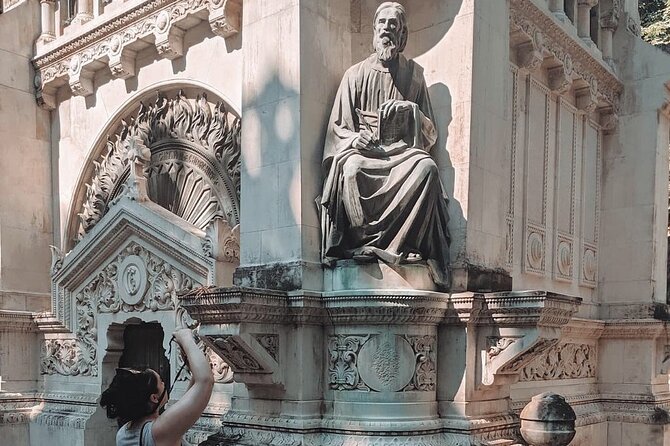
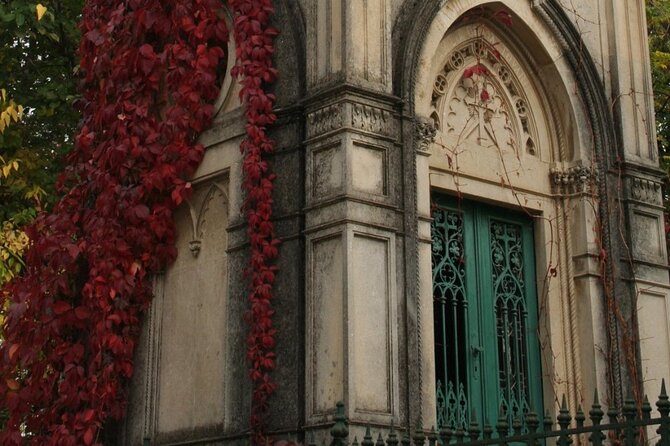
Bellu was the city’s first modern graveyard. Its paths lead past crypts, tombstones, sculptures, and family monuments, many of which carry their own small dramas. You may hear stories of love, social scandal, unusual deaths, celebrated Romanians, and mysteries that have not been fully explained.
The setting gives the guide something valuable: physical evidence. A name, statue, or monument turns an abstract anecdote into a place you can see. You are not simply being told that Bucharest had a complicated past. You are looking at the traces left by real people and families.
The cemetery is also a change of pace from central Bucharest. The city noise falls away, and the route becomes slower and more observant. You will want comfortable shoes, since the tour is primarily on foot and the cemetery portion alone lasts around an hour.
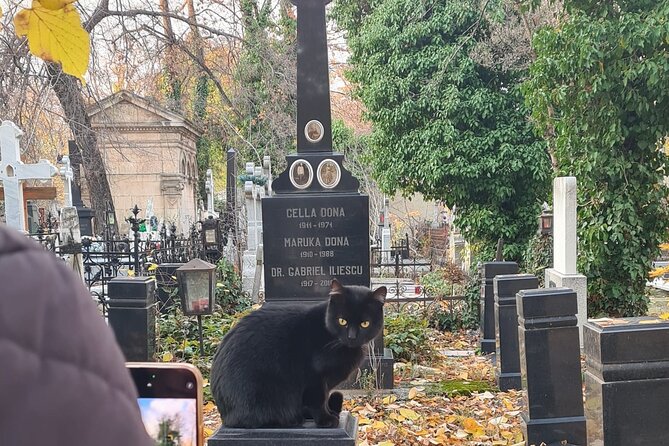
The strongest guides use Bellu’s monuments as starting points rather than rushing from grave to grave. Elena, for example, has been praised for bringing individual memorials to life with personal detail, folklore, and a little humor. One memorable story involves a woman associated with cats, an odd and darkly funny detail that shows the kind of unusual material this tour favors.
Animal lovers may also appreciate the guides’ affection for stray cats in the cemetery and city. One guide even paused to feed cats during the walk. That is not the main purpose of the tour, but it reflects the informal, human style you can expect from some guides.
University’s Square and the cost of protest
After Bellu Cemetery, the route returns to central Bucharest and stops at University’s Square for about 20 minutes. This is one of the most important protest sites in modern Romanian history.
The guide explains the 1989 Revolution, when people challenged the Communist regime, and discusses those who died during the fighting. You also hear about the miners’ clashes in the 1990s, when groups of miners were brought into Bucharest and confronted protesters who wanted a more Western political future.
The stop then moves toward the more recent anti-corruption movement. That connection matters. It shows that public protest did not end when communism fell. University’s Square continued to serve as a place where Romanians challenged political power and demanded a different kind of government.
Twenty minutes is not enough to cover every detail, but it is enough to place the square in the country’s wider story. The value comes from connecting events that can seem separate in a standard city tour: the revolution, post-communist unrest, and modern anti-corruption protests.
If you want a tour focused only on architecture, this stop may feel heavy. If you want to understand why Romania’s recent past still shapes public life, it is essential.
Calea Victoriei and Bucharest before communism
The walk along Calea Victoriei shifts the story back to the early 20th century. This section lasts about 40 minutes and focuses on the scandalous side of Bucharest before the Communist regime took power.
The period was not as polished as the grand boulevards might suggest. In 1927, around 12,000 prostitutes and escorts were working in Romania. The guide uses this subject to explore Bucharest’s nightlife, social divisions, celebrity culture, and the people who lived outside respectable public life.
One figure connected to this section is Zaraza, a beautiful Romani dancer remembered in popular stories. Her name helps the guide move beyond a list of dates and political leaders. You get a glimpse of the city as a place of music, desire, money, reputation, and danger.
This is one reason I like the route’s range. It does not treat Romania’s past as only a story of dictators and revolutions. You also hear about people whose lives were shaped by entertainment, romance, poverty, and scandal.
The exact balance depends on your guide. Alex, Andra, Elena, Vlad, and Bogdan have all led versions of the tour, and each brings a different personality. Several are praised for answering questions openly and adding local recommendations. Expect the guide to adapt the discussion rather than deliver identical lines with no room for conversation.
Same base, a completely different day:
- Bucharest: Palace of Parliament Tickets and Guide
★ 4.3 · 3,182 reviews - Bucharest: Day Trip to Dracula Castle, Peles Castle & Brașov
★ 4.4 · 3,049 reviews - Bucharest to Dracula Castle, Peles Castle and Brasov Guided Tour
★ 4.5 · 2,933 reviews - Bucharest: Palace of Parliament Tickets and Guided Tour
★ 4.4 · 1,877 reviews
Revolution Square and the final days of Ceaușescu
The tour ends at Revolution Square, in front of the Ministry of Internal Affairs. This is the emotional center of the experience and the place where the Communist regime’s collapse becomes easier to understand.
You hear about Romania’s political prison system, the suffering of ordinary people during the 1980s, and Nicolae Ceaușescu’s dictatorship. The guide explains what life was like under the regime, then returns to December 22, 1989, when shootings took place and civilians died while facing the Securitate.
The square is not treated simply as a photo stop. It represents the symbolic end of communist rule in Romania. The guide reconstructs how events unfolded and explains why this location remains so powerful for Romanians.
I find this final stop useful because it brings together the themes from the whole route. Bellu Cemetery showed personal stories and private grief. University’s Square showed protest. Calea Victoriei showed the city’s social life before communism. Revolution Square shows the public rupture that changed the country.
This part may be difficult for anyone who prefers history at a comfortable distance. The events are recent, and many families still carry memories of the period. The tour’s strongest guides keep the tone thoughtful, using humor in lighter sections but treating violence and loss with respect.
What the guides add to the experience
The guide is the main reason to book this tour rather than walk the same streets alone. The route is easy to follow once you know the stops, but the meaning of the cemetery monuments and protest sites is not obvious from the outside.
Vlad is praised for strong English, vivid anecdotes, and an easy way of speaking. He has also been attentive to practical needs, including offering water during a very hot day and taking photos for the group. Alex is described as open, humorous, and especially strong on the Romanian Revolution. Andra is praised for clear explanations and an energetic approach to history.
Elena brings a more personal style, mixing family background and local insight with the historical material. Bogdan is a good fit if you like asking questions and want a guide who can provide a broad explanation of Bucharest and Romania.
You cannot choose a specific guide from the information provided, so treat these names as examples of the team rather than a guarantee. The consistent pattern is clear: this experience depends on storytelling, English communication, and the guide’s ability to handle dark subjects without becoming theatrical.
Price, group size, and the practical value
The cost is $48.39 per person. That is not the cheapest way to spend three hours in Bucharest, but it is reasonable for a small group capped at 12 people, especially since subway transportation and a street snack are included.
The value is not in admission tickets. Bellu Cemetery and the public squares do not require an entrance fee. You are paying for access to organized stories, local context, and a guide who can connect places that you might otherwise visit without understanding.
The included snack is a small touch, often described as a pretzel in the tour experience. It will not replace a meal, so eat beforehand if you need substantial food. Drinks and other food are not included.
The tour starts at 3:00 p.m. near the Ion Luca Caragiale National Theatre on Bulevardul Nicolae Bălcescu and ends at Revolution Square. There is no hotel pickup or drop-off. Since the tour finishes in central Bucharest, you can continue sightseeing or find dinner nearby, but you will need to arrange your own way back to your hotel.
The route uses the subway and includes plenty of walking. Wear comfortable shoes and bring water, especially in hot weather. The tour requires moderate physical fitness, and weather can affect the schedule.
Who should book this tour
I would choose this experience if you want to understand Bucharest through stories that standard sightseeing tours often skip. It suits people interested in political history, cemeteries, folklore, crime, social history, and the personal side of dictatorship.
It is also a good choice for a first visit. The route gives you useful context for later exploring the city, especially if you plan to visit other Communist-era sites or museums. You will leave with a clearer idea of how Romania’s past still shapes its public spaces and conversations.
The tour is not recommended for children aged 15 and under. That age guidance makes sense given the discussions of death, prostitution, political imprisonment, shootings, and state violence.
You should think twice if you dislike walking, find cemeteries uncomfortable, or want a relaxed introduction to Bucharest with only cheerful stories. This is an afternoon of serious subjects, even when the guide adds humor.
Is the Darkside Tour of Bucharest worth booking?
Yes, if you want a personal and unusual introduction to Bucharest. The strongest parts are Bellu Cemetery, the clear explanation of the 1989 Revolution, and the guides’ willingness to answer questions and share local detail.
At $48.39, the tour is best value for someone who cares about stories more than ticketed attractions. Book it for the guide, the small group, and the chance to see Bucharest through its difficult memories. Skip it only if you want a lighter city walk or cannot manage three hours of walking and serious historical material.
Free cancellation is available up to 24 hours before the start time. If bad weather forces cancellation, you can receive a different date or a full refund.
FAQ
How long is the Darkside Tour of Bucharest?
The tour lasts approximately three hours.
How much does the tour cost?
The listed price is $48.39 per person.
What language is the tour offered in?
The tour is offered in English.
Where does the tour begin?
It begins at the Ion Luca Caragiale National Theatre, Bulevardul Nicolae Bălcescu 2, Bucharest.
Where does the tour end?
It ends at Revolution Square, in front of the Ministry of Internal Affairs.
What time does the tour start?
The start time is 3:00 p.m.
Is subway transportation included?
Yes. Subway transportation is included in the experience.
How large is the group?
The group has a maximum of 12 travelers.
Can I cancel for a full refund?
Yes. You can cancel at least 24 hours before the local start time for a full refund. Changes or cancellations made less than 24 hours before the start time are not accepted, and poor weather may lead to a rescheduled date or full refund.
Just added around Bucharest
- Bucharest Panoramic City Tour & Street Food★ 5.0 · 4 reviews
- Bucharest City Tour with Village Museum★ 4.6 · 5 reviews
- Bucharest: Communism, Revolution & City Highlights Tour★ 5.0 · 9 reviews
- Bucharest City Tour – A Day to Remember★ 4.6 · 3 reviews
- Bucharest City Tour and Wine Tasting★ 5.0 · 3 reviews
- Bucharest: Private City Tour Guided Experience★ 4.8 · 8 reviews
- Bucharest: Charm of the Belle Époque Private Tour★ 5.0 · 3 reviews
- Bucharest: Carpathian Snowmobile / ATV Adventure Tour★ 5.0 · 8 reviews
Tours in Bucharest, compared.
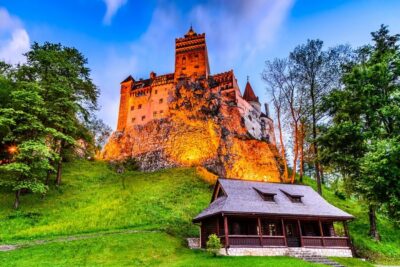
Dracula’s Castle, Peles Castle, & Brasov Old Town
Read our review →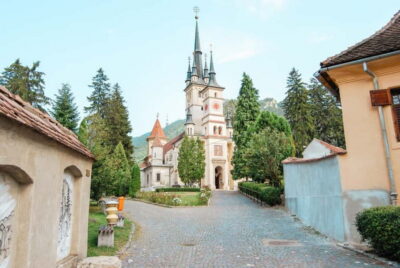
Dracula’s Castle, Peleș Castle & Brașov Day Trip
Read our review →
Day Trip to Dracula Castle, Peles Castle & Brașov
Read our review →
Bucharest to Dracula Castle, Peles Castle and Brasov Guided Tour
Read our review →
Dracula’s Castle, Peles Castle and Brasov Day Trip from Bucharest
Read our review →
Transylvania and Dracula Castle Full Day Tour from Bucharest
Read our review →Browse the lists this tour appears in